Secure your Azure Landing Zone
A well-designed Landing Zone is not enough: it has to be protected. Identity as the new perimeter, just-in-time access, Zero Trust networking and compliance, with PIM and Bastion demos and a serverless case study.
- Events
-
- 1nn0va Saturday 2024 · · Pordenone · Conference presented as “Deep dive into Azure Landing Zone Security”
- #POWERCON2024 — Rivoluzione digitale in azione · · Online · Conference
- Level
- Intermediate
The problem and the context
When people talk about Azure Landing Zones they usually think about structure: management groups, subscriptions, hub & spoke networking, policies. All correct, but a tidy Landing Zone is not automatically a secure one. This session starts exactly from there: take the eight design areas of the Cloud Adoption Framework and look at them through the eyes of whoever has to defend the environment.
I delivered the extended version at 1nn0va Saturday 2024, titled “Deep dive into Azure Landing Zone Security”, and a more compact one at #POWERCON2024. The audience is sysadmins, cloud engineers and architects who already run an Azure environment, or are about to build one, and want to understand which services to use to protect it and in which order to think about them.
Key content
Where to start: the reference Landing Zone
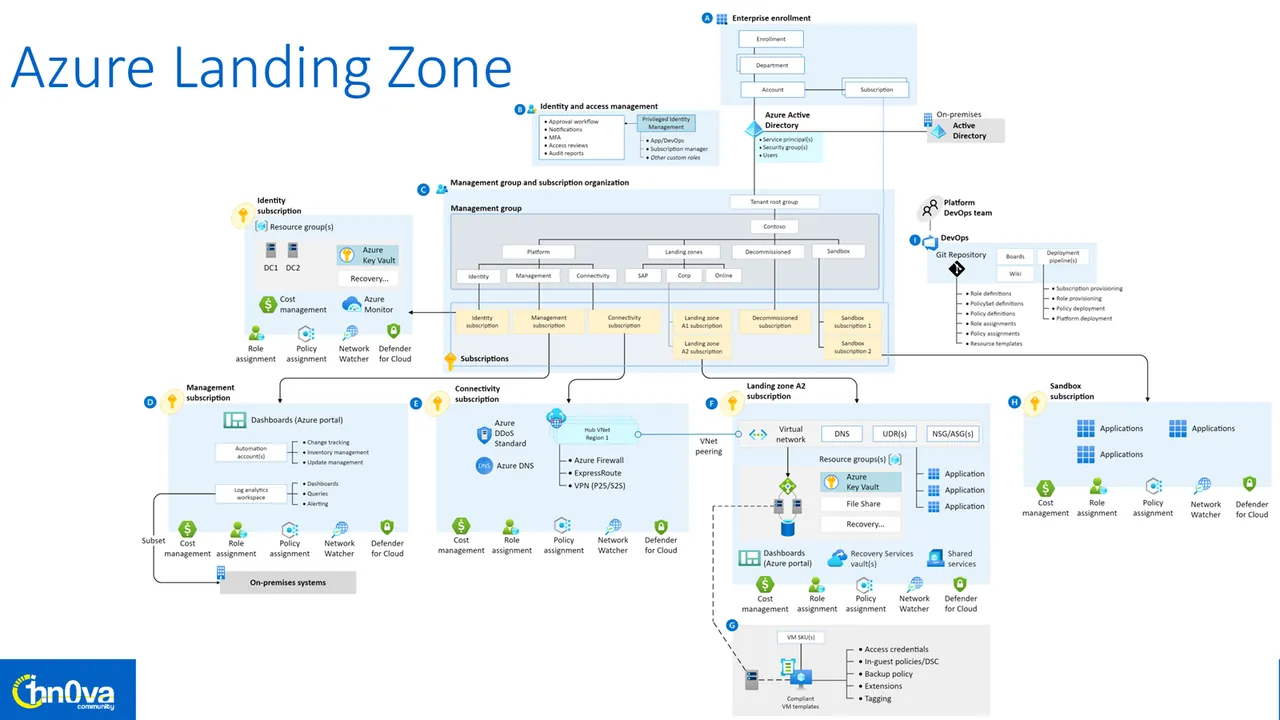
I start from Microsoft’s definition: a Landing Zone is an environment that follows shared design principles across eight areas, from tenant and billing to identity, resource organization and networking, up to security, management, governance and automation. You don’t need to start from a blank page: the Azure Landing Zone Accelerator deploys a reference Landing Zone from the portal or through IaC, with Bicep or Terraform, in a few minutes. Then you customize it.
Identity is the new perimeter
The core of the session is something I keep repeating: the perimeter to defend is no longer just the network, it is identity. In a Zero Trust approach privileged accounts must be managed with Just-in-Time Administration and Least Privilege, and the identity solution must be centralized and integrated with the rest of the technology stack.
In Azure that means Microsoft Entra ID, natively integrated with the RBAC model and able to be hybridized with on-premises Active Directory. I explain how RBAC permissions apply at different scopes (management group, subscription, resource group, single resource) and are inherited downwards: understanding this hierarchy well is the first step to avoid handing out overly broad permissions.
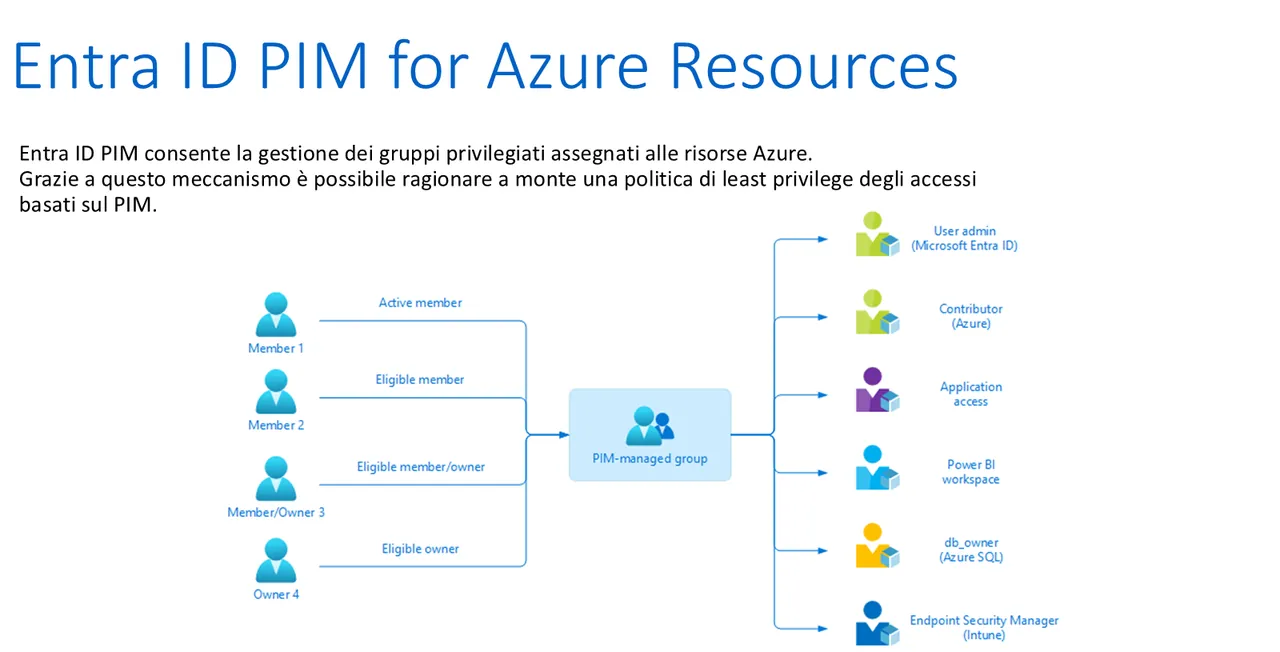
The next step is Entra ID PIM for Azure Resources: instead of permanent assignments, you design privileged groups up front that are activated only when needed. I also wrote about it in the post on Entra ID PIM for resource groups.
Landing Zone security is a continuous process, and identity must sit at the center of the design: no solutions each bringing its own identity system.
Reaching VMs without exposing them
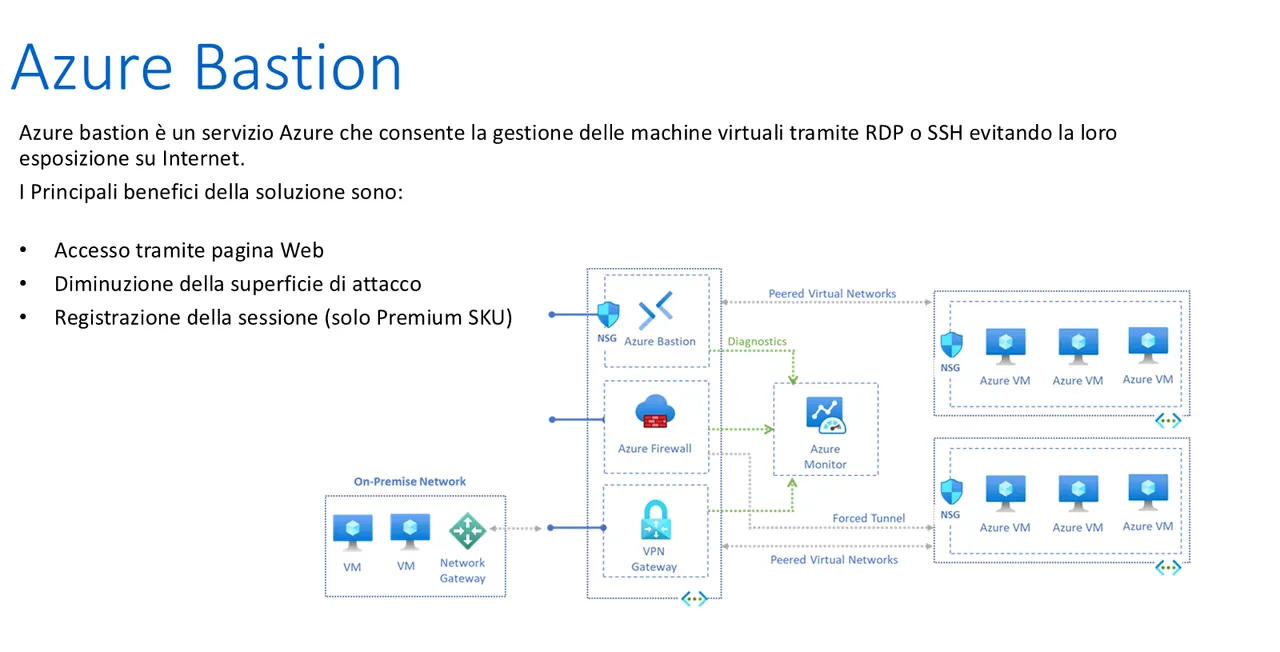
For virtual machine management I present Azure Bastion: RDP/SSH access from a web page, no public IPs on the VMs and therefore a smaller attack surface. I go through the four available SKUs and what changes between them, for example session recording, which at the time of the session was available only with the Premium SKU.
| SKU | When it makes sense |
|---|---|
| Developer | Test and development environments |
| Basic | Basic access to VMs in the same network |
| Standard | Enterprise scenarios with advanced features |
| Premium | Audit requirements, such as session recording |
Security & Compliance
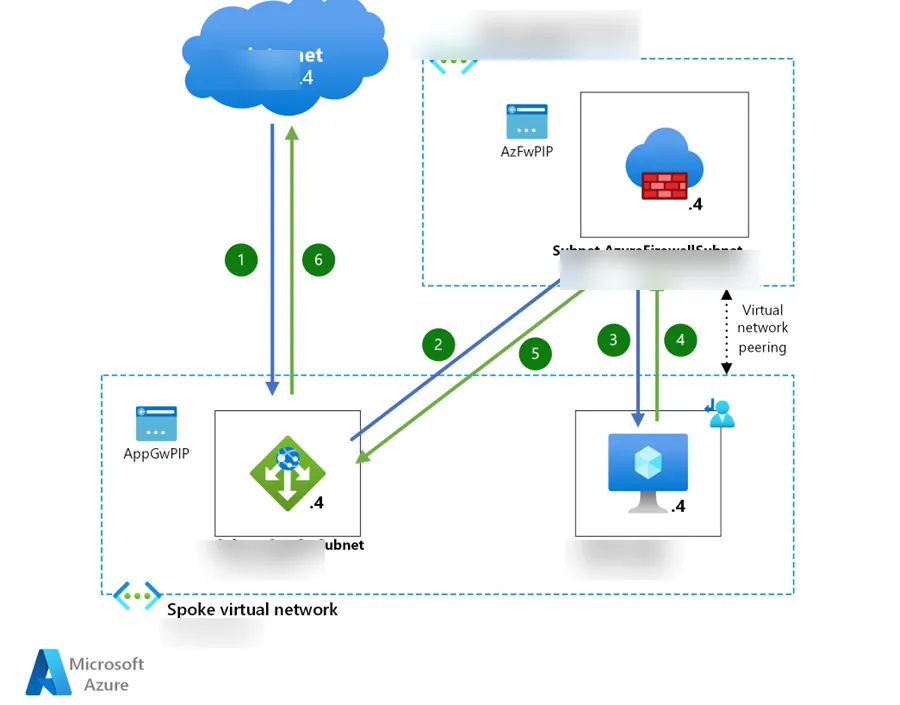
On the network side, the message is that Zero Trust principles must be applied throughout the design. Combining Azure Firewall + Application Gateway v2 + WAF v2 lets you protect internet-facing workloads with highly available PaaS services that integrate with each other.
The picture is completed by:
- Microsoft Defender for Cloud, with Just-in-Time VM Access: ports opened only on request, only the required ones and only for a defined time;
- Azure Policy, to enforce organizational standards, get an aggregated compliance view and remediate existing resources at scale;
- Azure Backup, with Azure Files and Blob backup, immutability and backup encryption.
Architectures and demos
There are two demos. In the first I show Entra ID PIM applied to Azure resources: an eligible role assignment and its just-in-time activation.
In the second demo I use Azure Bastion to connect from the browser to a VM with no public IP.
For networking I use the reference pattern with Application Gateway and WAF in front of Azure Firewall: inbound traffic goes through the L7 load balancer with WAF, is inspected by the firewall in the hub and only then reaches the backend in the spoke.
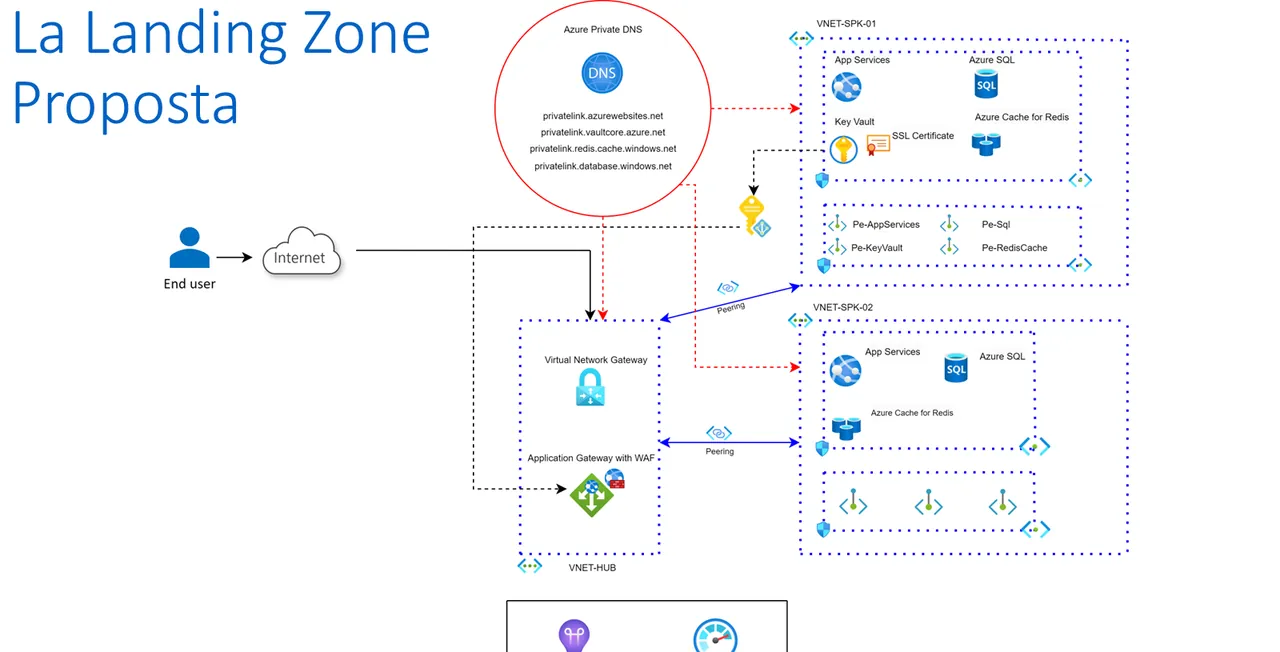
I close with a case study: a company wants to build a new serverless infrastructure on Azure to deliver SaaS applications to its customers. The requirements are three: make the PaaS resources private, protect the published web applications with a WAF, and design a Landing Zone suited to a serverless environment. The proposed Landing Zone, shown in the opening image, brings together everything covered in the session: privately reachable PaaS, WAF-protected ingress and centralized traffic control.
Lessons from the field and takeaways
- Landing Zone security, and Azure security in general, is a continuous improvement process, not a project with an end date.
- Security people are not there to make life easier for IT and users, but safer.
- Start from the Azure Landing Zone Accelerator instead of from scratch, then adapt.
- Use Managed Identity and Key Vault wherever possible to govern web application passwords and certificates.
- Infrastructure monitoring is part of the process, never optional: you can’t govern what you don’t know.
- Put identity at the center: one identity system, just-in-time privileged access with PIM.
- No public IPs on VMs: Bastion plus Defender for Cloud JIT, as I also describe in the post on multi-layer VM protection.
Resources
Microsoft Learn documentation
- What is an Azure landing zone?
- Assign Azure resource roles in Privileged Identity Management
- What is Azure Bastion?
- Firewall and Application Gateway for virtual networks
- Enable just-in-time access on VMs
- Overview of Azure Policy
Recordings
- Watch / listen to the recording — #POWERCON2024 — Rivoluzione digitale in azione
- Session page on Sessionize
Related blog posts
Other sessions
Cloud Governance & Security: Azure at its best
From Landing Zone to Zero Trust: how to set up governance, networking, identity and workload protection in Azure with Azure Policy, Microsoft Defender for Cloud, Azure Bastion and Entra ID PIM.
- Webinar WeAreProject — Cloud Governance & Security · 2026
- Azure Policy
- Azure Monitor
- Microsoft Defender for Cloud
- Microsoft Entra ID
- Azure Bastion
- Azure Firewall
- +1
Agents at work – l'intelligenza che agisce
Three digital colleagues in half an hour: GitHub Copilot for developers, Microsoft Scout for people working across mail, files and portals, Microsoft Foundry for enterprise agents. Real cases, demos and one rule: delegate the work, not the responsibility.
- Agents at Work: Meet Your New Colleagues — WeAreProject · 13 October 2026
- GitHub Copilot
- Microsoft Scout
- Microsoft Foundry
- Work IQ
- Microsoft Entra ID
- Microsoft Intune