Azure Expert certifications: exam tips and study material
Azure Expert certifications SC-100, AZ-400 and AZ-305: my path, the courses, the books and practical tips to prepare for and pass Microsoft exams.
Last updated on
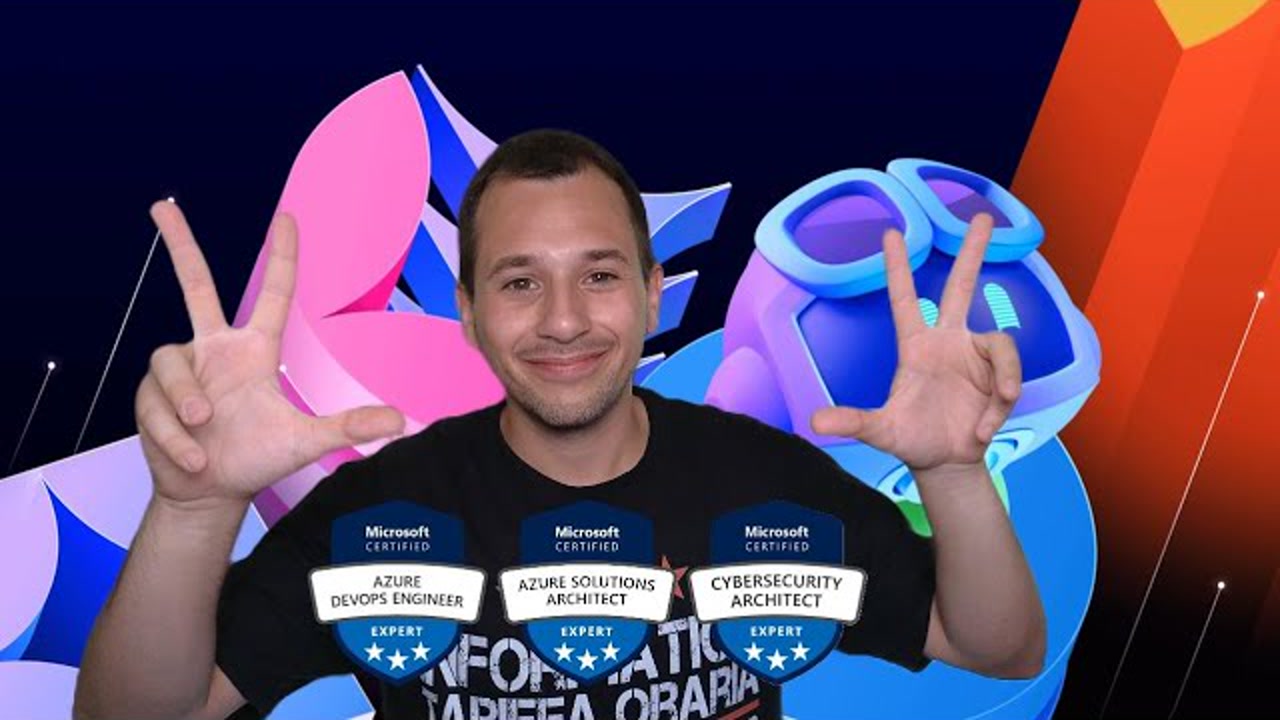
Table of Contents
After completing the three main Azure Expert certifications, I felt the need to take stock. Not to line up badges, but to share what I learned along the way: the order in which I took the exams, what gave me trouble, which courses and books I used and how I organize my study. A note: the exams, contents and courses mentioned refer to what was available at the time the video was recorded.
The three “queens”: the Azure Expert certifications
Microsoft organizes its certifications in levels: Fundamentals, Associate and Expert. For Azure, the three Expert ones I like to call “the queens” are these:
| Exam | Certification | Requirement / path | What it gave me |
|---|---|---|---|
| SC-100 | Cybersecurity Architect | I got there after AZ-104 and AZ-500 | Security at the core of design, identity, the bridge between Azure and Microsoft 365 |
| AZ-400 | DevOps Engineer | The exam I found hardest | Git, pipelines, Azure DevOps, Infrastructure as Code |
| AZ-305 | Azure Solutions Architect | Earned together with AZ-104 | The big picture and architectural reasoning |
I followed a slightly unusual order. I started with AZ-104, which is still an excellent introduction to the platform, and then deliberately waited before taking AZ-305.
SC-100: starting from security
The first “queen” was Cybersecurity Architect, after going through AZ-500 (Azure Security Engineer). It made me understand that security must always be the cornerstone of infrastructure design: we can build the most beautiful application in the world, geo-distributed and with the most sophisticated backup, but if it isn’t secure it’s a missed opportunity.
SC-100 is also interesting because it isn’t only about Azure, it covers Microsoft 365 too. They look like separate worlds, but they share many touchpoints: when we talk about access to and administration of Azure resources we inevitably talk about Entra ID, a topic shared by infrastructure, security and 365. Identity is central and changes the way you think about the cloud.
A certification doesn’t make us experts, but it gives us a great starting point: concepts we have at least seen and can then dig into in a project, a POC or our home lab.
A concrete example: the multi-layer VM protection I presented at WPC, based on Entra ID PIM, Defender for Cloud Just-in-Time VM Access and Azure Bastion. Tools I had found discussed together while studying for SC-100. When I had to build it for a customer I wasn’t starting from scratch: some testing, then production.
AZ-400: the exam that put me in crisis
Swept up by a project based on Bicep and Infrastructure as Code, I took AZ-400. Of all the exams it’s the one that gave me the hardest time: I have no development background, and many programming concepts were missing. Git, for instance, I really discovered there, and it was a game changer.
In the same period I discovered GitHub Copilot: while studying Git I asked it questions and it helped me understand better. Pipelines, boards, development approaches, the ever-tighter integration between GitHub and Azure DevOps: topics barely covered in other certifications, yet fundamental. Once we start thinking in Infrastructure as Code terms we cross into the dev world, and our developer colleagues have a lot to teach us. Today I would start from there for landing zone design too: replicable environments and versioning of the whole infrastructure.
My advice, if you’re thinking “I’m not a developer, AZ-400 isn’t for me”: give it a chance.
AZ-305: design, choices and the big picture
Many colleagues take AZ-305 right away. I think it deserves some time: it’s an exam about design (which architectural choice given these parameters, what do I change to save money), and to get the most out of it you should have worked in Azure and understood how it works behind the scenes.
A question I enjoyed: how to send the logs of an Azure resource to a third-party SIEM run by an external SOC. With Sentinel there’s a connector; with a different SIEM you need an Event Hub. I knew it because I’d dealt with it on a project shortly before the exam. Where I was weaker was the Data Platform: many questions on Azure SQL and SQL Managed Instance SKUs, migrating database-based applications, Fabric and Synapse.
Data aside, I found it easier than AZ-104 in terms of questions, with little security. What it left me is the vision: after a while you get into the “I have ten objects, how do I place them, which landing zone, whom do I ask” mindset. The architect isn’t a mad scientist who knows everything, but a tentacular figure: someone with the big picture who works with vertical teams, knowing for example that AKS isn’t the only container option and that Application Gateway isn’t the only WAF, there’s Front Door too.
The material I used
I take Microsoft Learn learning paths for granted. On top of them I always add books and recorded courses, because they bring the authors’ field experience.
- Books: for security, Mastering Azure Security (first and second edition); for architecture, Azure Cloud Adoption Framework Handbook, covering landing zones, migrations, cloud native approaches and how to talk with finance, marketing and management. A book has a beginning and an end: topics follow a meaningful path.
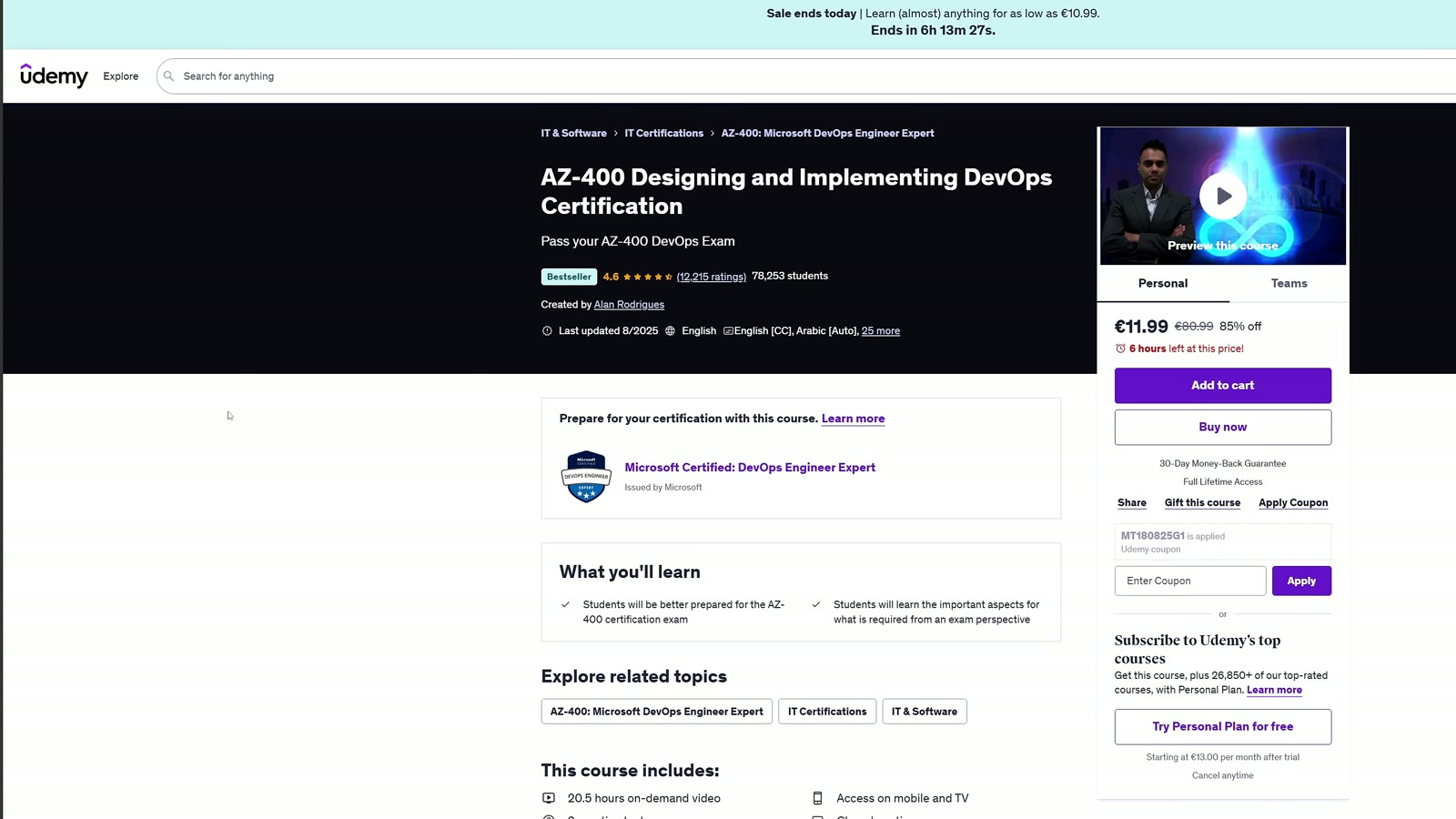
- Udemy courses (in English, bought by me, no sponsorship): for AZ-400, Alan Rodrigues’s course, long and packed with exercises and code you can push to your own repositories and have Copilot explain.
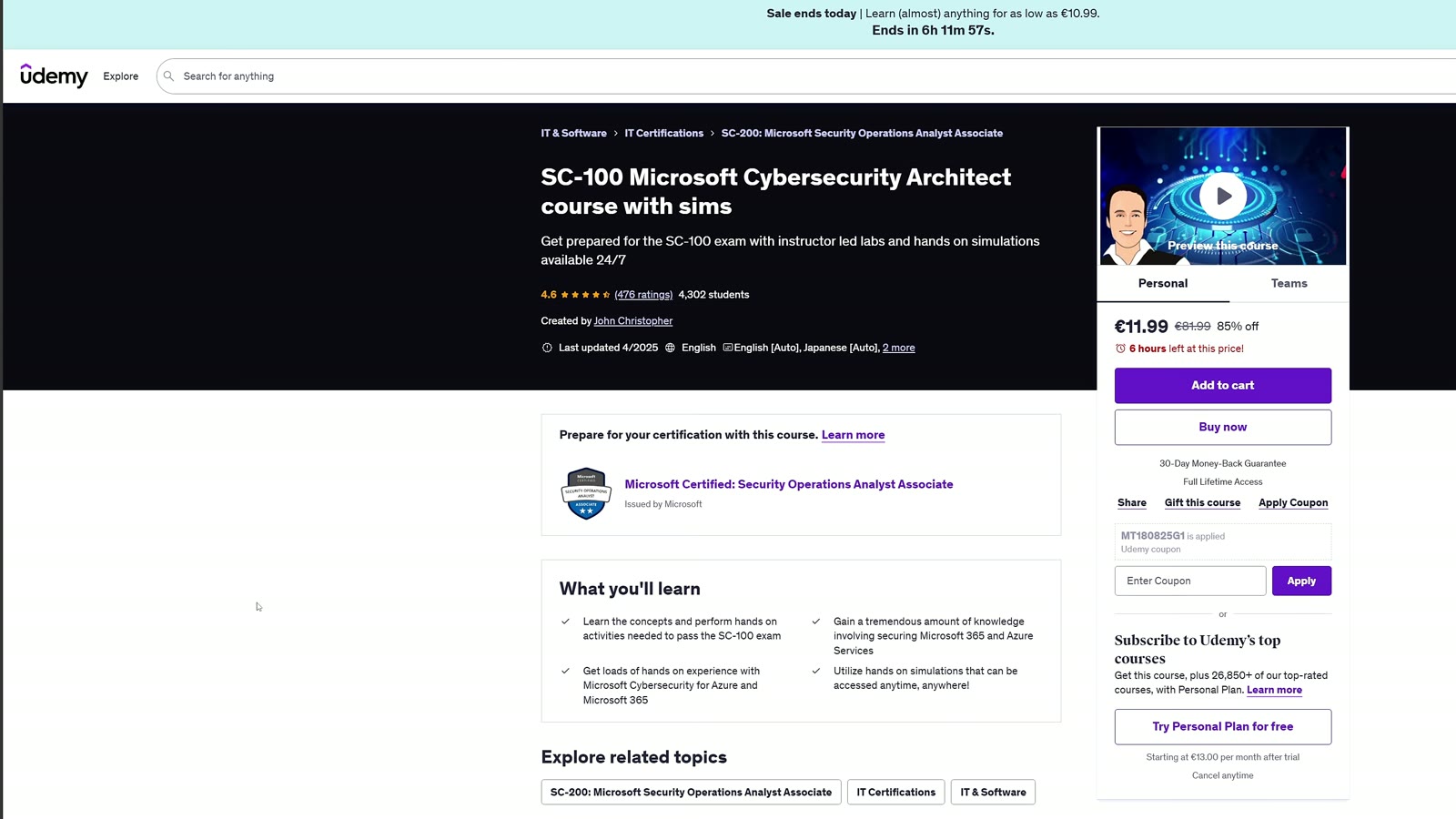
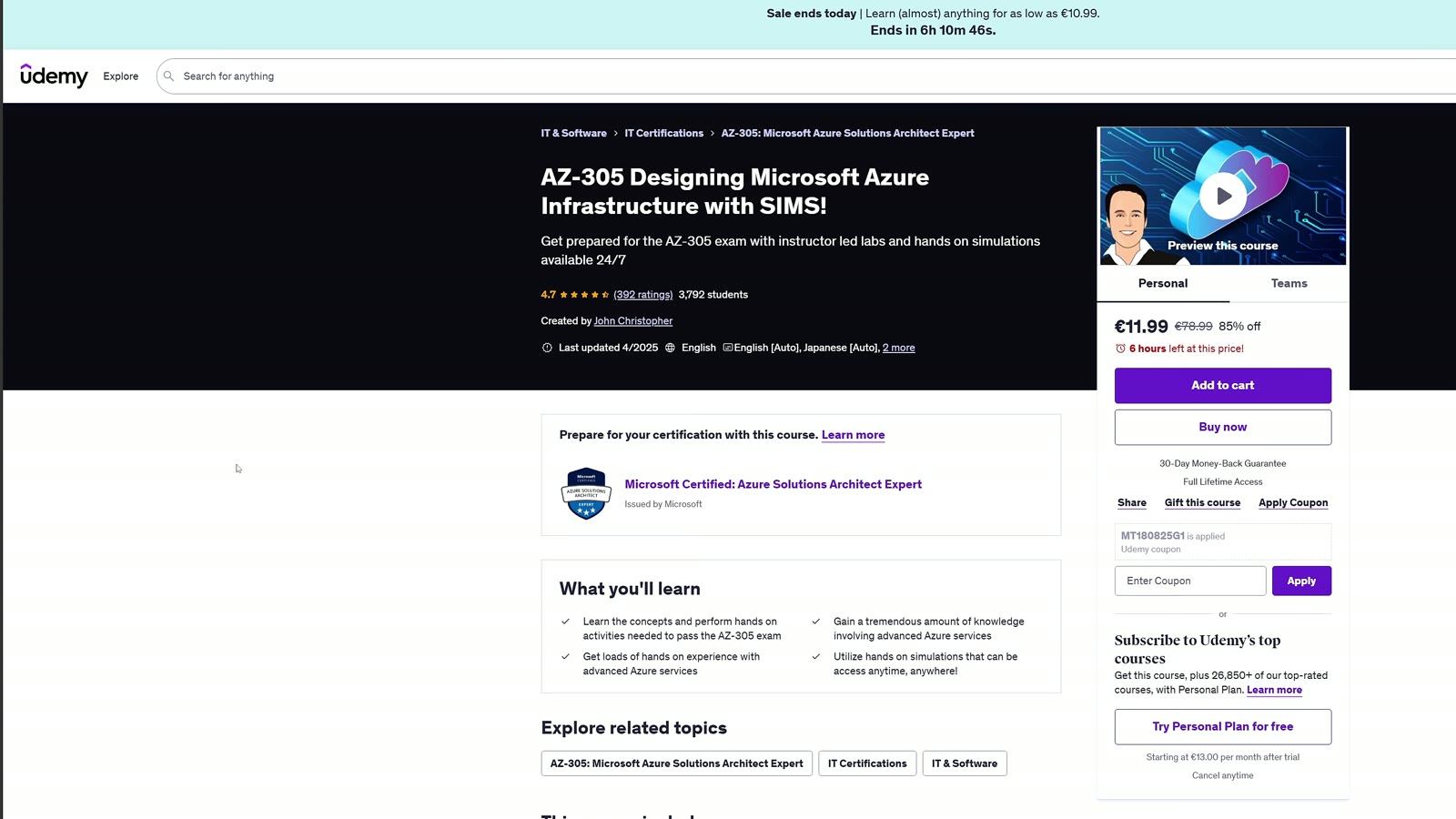
For SC-100 and AZ-305 I chose John Christopher: more concise and lean, I prefer him when I already know the topic a bit and want a structured but fast course.
Instructor-led four- or five-day classes with a skilled, hands-on trainer are still great, but in my experience I ended up doing the labs in the evening.
The exam page and the study guide
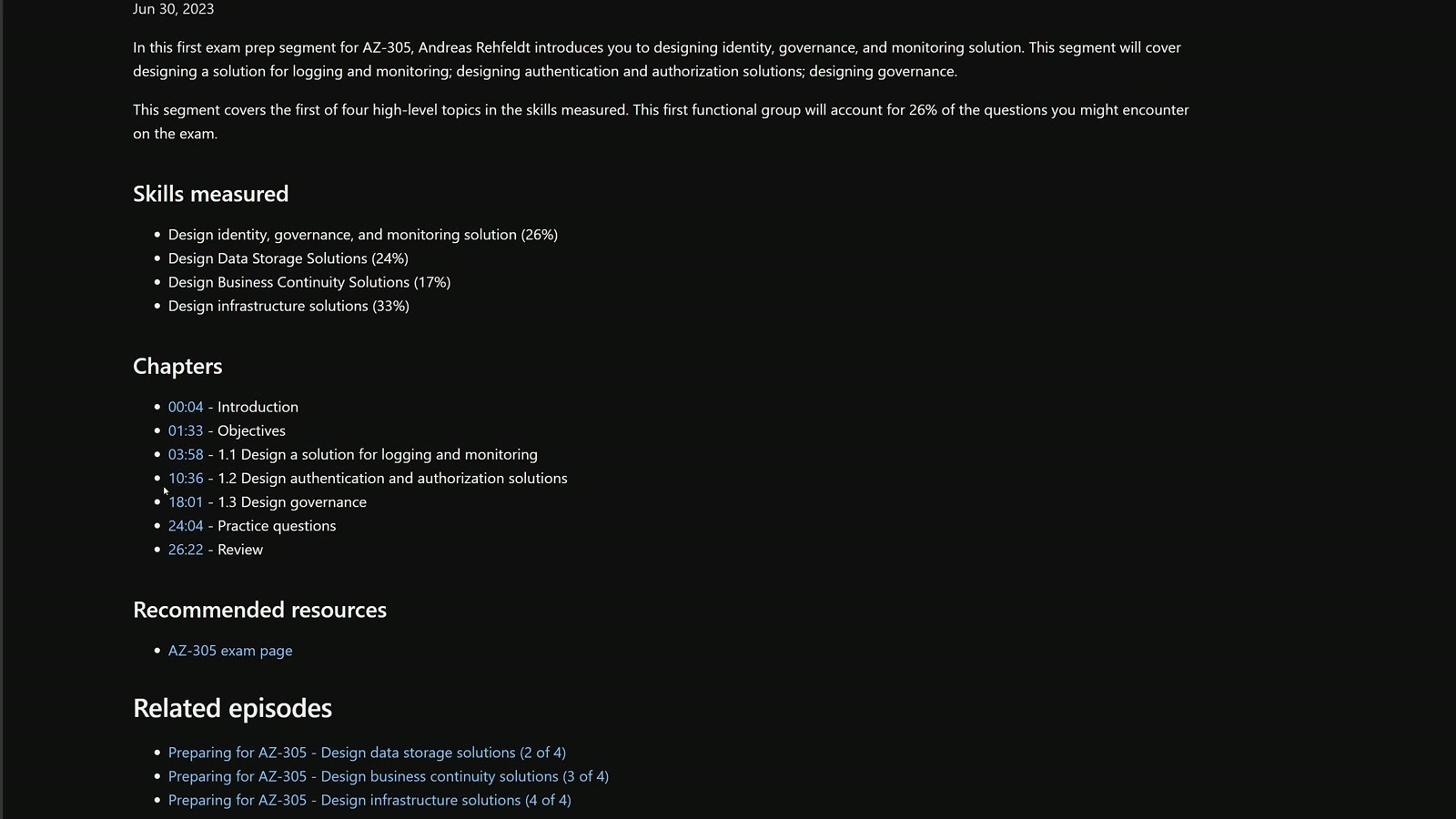
From the exam page on Microsoft Learn you can also reach dedicated videos: personally, I didn’t find them that useful.
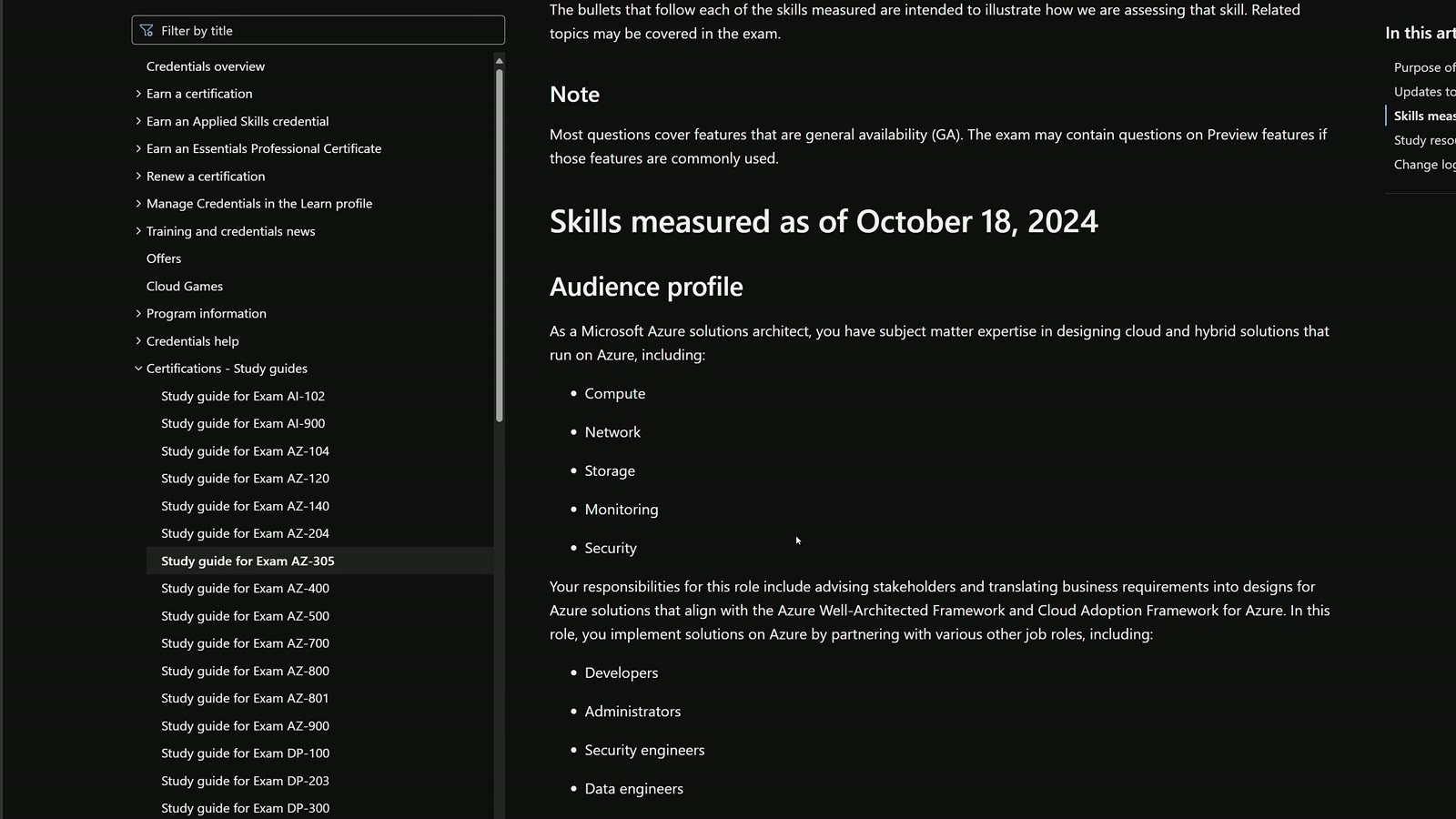
The study guide, on the other hand, must be read carefully: it tells you what you need to know and how much each area weighs. If a topic weighs 10-15% and you don’t get it, study it, while knowing how much it counts.
Practice, timing and renewals
A course must always go together with practice: open an Azure subscription and test. Microsoft offers an initial credit and many free resources; by turning resources on and off sensibly you can get a lot done. Azure DevOps is free for the features you need for AZ-400.
For each exam I take two to three months: I’m not interested in rushing, I want to understand. And after the exam I keep digging, because some topics are covered lightly; right now I’m focusing on containers and Kubernetes. Certifications last one year and the free renewal can be taken in the six months before expiry: a cycle that forces me to study again and stay current.
Key takeaways
- The three Azure Expert certifications (SC-100, AZ-400, AZ-305) give you foundations and a different mindset, not experience.
- Starting from security puts it at the center of every design.
- AZ-400 is worth it even if you’re not a developer: Git and IaC change how you work.
- AZ-305 pays off more after hands-on Azure work; watch out for the Data Platform.
- Learn + a good course + a book + lots of practice, with the study guide as your compass.
Watch the video and let’s talk
The full story is in the video on YouTube, with more content on my YouTube page. Want to know more about me? Check About. Questions about the exams? Message me on LinkedIn or find my talks on Sessionize.

Written by
Cloud Solution Architect and Microsoft Azure MVP: landing zones, networking, security and hybrid cloud from the field.
Related articles
GitHub Copilot CLI with managed identity: hub & spoke on Azure
I run GitHub Copilot CLI on Azure Virtual Desktop with the VM's managed identity and MCP servers to deploy a hub & spoke network on Azure.
Always-on AI agent on Azure Virtual Desktop that works for you
How I built an always-on AI agent on Azure Virtual Desktop with Hermes Agent and GitHub Copilot: Word docs, news digests and Telegram.
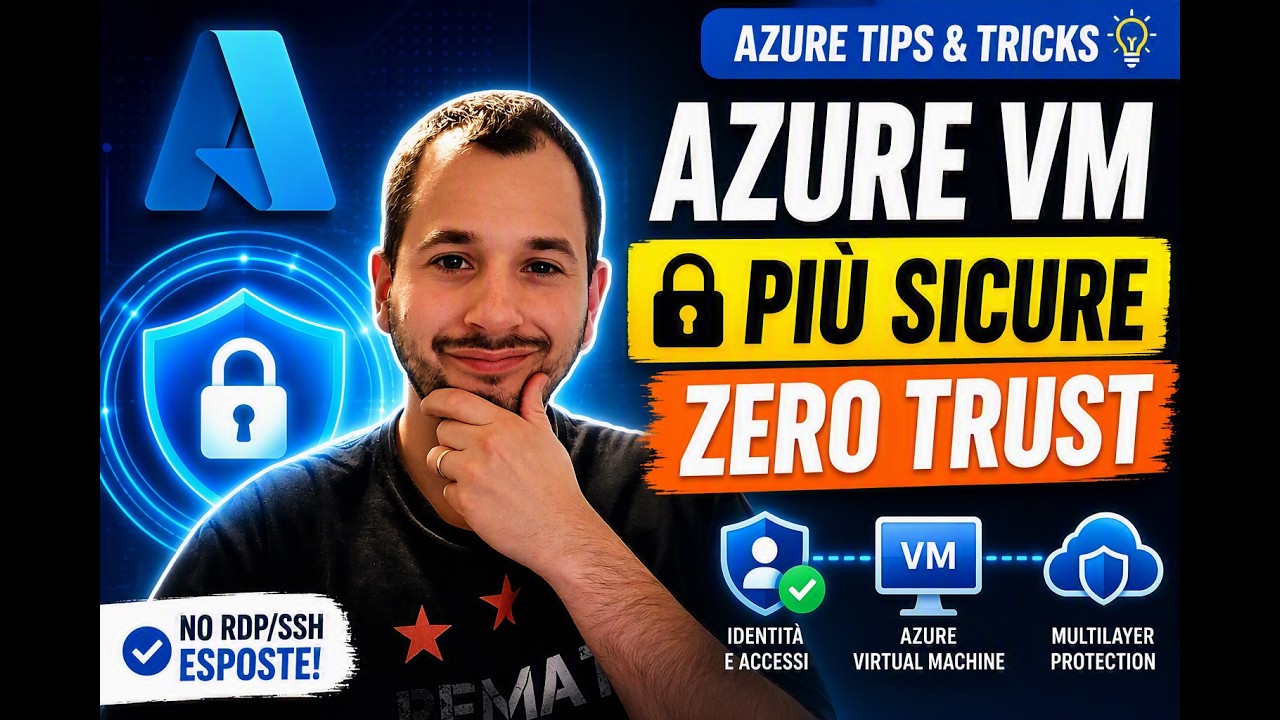
Multilayer protection for Azure virtual machines: JIT, Bastion, PIM
Multilayer protection for Azure virtual machines: Defender for Cloud JIT, Azure Bastion and Entra ID PIM combined for secure, audited VM access.